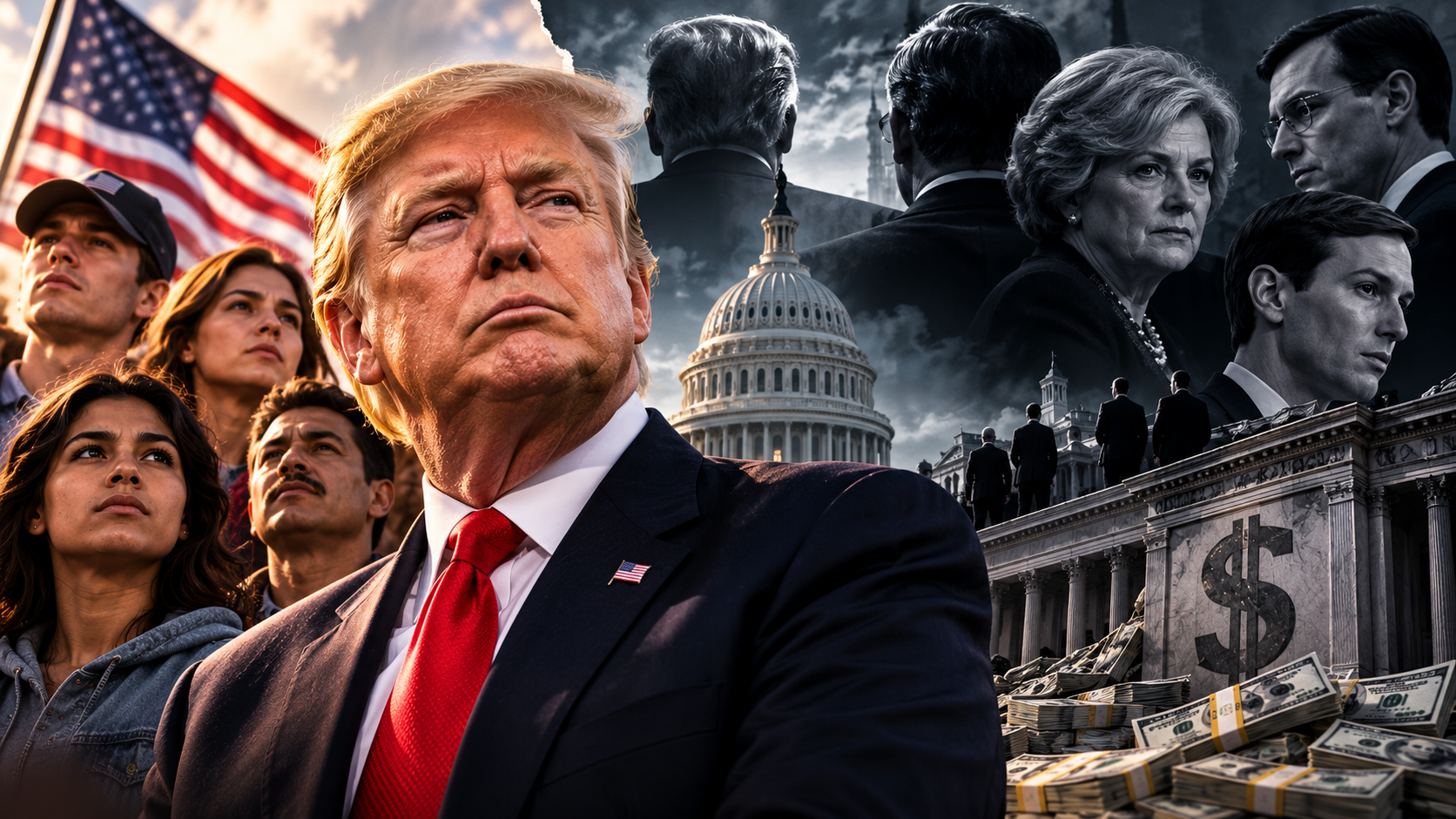
My daily tracking of the 2024 race showed Trump with a pretty safe roughly two-point national popular-vote lead for most of the election season. But with the pitfalls of state polling, and an increasingly complicated relationship between the national House vote and actual seat gains, the Republican trifecta still hit many people as a surprise. Many called it a mandate, perhaps not because of the size of the margins — Trump ultimately won the popular vote by about a point and a half, and Republicans actually lost seats in the House — but because so many of the components of Trump’s platform were massively popular. In many cases, they were more popular than Trump himself and certainly more popular than the Republican Party, which has struggled with its brand for decades.
Trump’s 2024 coalition was also fundamentally different from his coalition in 2016. He won more than 77 million votes, and in Rasmussen’s final 2024 polling, 42% of Trump’s electorate came from independents and Democrats. He made enormous gains with young voters, Hispanics and other groups Republicans had been assured for years they could never reach. Those voters expected results. Needed results, in fact. Despite voters’ propensity to put the economy at or near the top of every list, the fundamentals in 2024 reflected something much bigger: a sense of failing capitalism, the death of the American Dream, and profound mistrust and anger directed at corporations and institutions — most especially the federal government. If 2016 was a “coalition of the curious,” 2024 was a “coalition of the desperate.”
And that created a trap for Trump. His domestic agenda depended heavily on a Republican Party perennially predisposed to inaction, and on a political infrastructure that his electoral victory had not actually replaced. Politically, Trump’s second term has not met the expectations of a significant portion of the coalition that put him back in office. Although many will point to Iran as the inflection point, his deterioration began well before it. His approval lost ground beginning in the spring of 2025 and has continued steadily and inexorably downward, bringing him to the lowest approval in decades at this point in a second term. Republican support of Trump has remained comparatively strong; the real collapse has occurred among independents and many of the younger, Hispanic and crossover voters who made his 2024 victory possible. Certainly, DOGE fading from center stage, Midnight Hammer and the subsequent Iran war, the Epstein debacle, and the administration’s often horrendous messaging have taken their toll. But dissatisfaction with a Republican Congress that has delivered far less than many of these voters expected is also on the ballot this fall. Not only that, at every turn out-of-touch establishment GOP politicians, mouthpieces and talking heads show an excruciating inability to address this shortcoming or even come up with a passable message to run on in November. We’re mostly seeing variations of “vote red or you’re dead,” which fail to address the inescapable reality that Republicans failed to convert many of these non-ideological Trump voters into ideological Republicans — and that some economic policies once dismissed as “socialist” are increasingly popular even among Republican voters.
This presents an uncomfortable question: How does a populist movement take over a political party without eventually being taken over by the political party? Trump proved that an outsider could capture the Republican electorate. He did not prove that an outsider could replace the Republican political machine, and that distinction matters. Winning an election does not magically create a parallel ecosystem of policy experts, political appointees, consultants, lawyers, vendors, think tanks, advocacy groups, fundraising networks and experienced government personnel. An insurgent president can arrive in Washington having defeated the establishment electorally, only to discover that he needs much of the establishment’s infrastructure to govern. And that infrastructure comes with interests of its own.
There is remarkably little evidence that Trump’s electoral revolution produced a corresponding revolution in that infrastructure. Corporate and billionaire money did not retreat from Trumpism; it flooded into it. The old consultant, donor and congressional networks did not disappear. Trump has used his enormous influence over Republican primary voters far more often to protect incumbents than to replace them, while establishment-backed candidates continue to defeat populist challengers. Perhaps most revealingly, the ideological institutions surrounding Republican government have not undergone anything resembling the transformation of the Republican electorate. Trump changed who votes Republican much faster than he changed who funds, staffs and operates Republican politics.
Project 2025 is almost too perfect an illustration. Whatever one thinks of its individual proposals, the entire purpose of the project was to solve exactly this problem: develop policy in advance, identify and train thousands of ideologically aligned personnel, and create a governing infrastructure that could enter Washington on Day One without immediately becoming dependent upon the permanent political class. Yet Trump’s own campaign publicly went to war with it. Susie Wiles and Chris LaCivita repeatedly distanced Trump from Project 2025 and celebrated reports of its demise. People directly involved with the project have since told me that the internal effort to marginalize it went even further than has been publicly reported. I cannot independently substantiate every account I have heard, but the publicly documented fight itself is extraordinary: a movement that spent years complaining that Trump’s first administration was undermined by hostile or ideologically incompatible personnel built an enormous operation specifically intended to prevent that from happening again — and Trump’s own political operation helped sideline it.
DOGE followed a strangely familiar trajectory. Elon Musk entered Washington promising the kind of assault on the administrative state that much of Trump’s anti-establishment coalition had demanded for years. Within months, the initiative was diminished and Musk was gone amid well-documented tensions with the White House and Cabinet officials. Immigration produced its own version of the same conflict. Trump campaigned on the largest deportation operation in American history, then publicly acknowledged that aggressive enforcement was removing longtime workers from farms and hotels after those industries complained. His administration briefly restricted enforcement at farms, restaurants and hotels before reversing itself days later. Meanwhile, one of the most prominent comprehensive immigration proposals to emerge from Republicans in Congress, the bipartisan Dignity Act, would allow qualifying illegal immigrants who have been here since before 2021 to obtain renewable legal status. Its sponsors insist this is not amnesty, and the bill also contains substantial enforcement provisions. Fine. But it is difficult to imagine a better demonstration of the gravitational pull of Washington than watching a movement elected on mass deportation arrive in power and almost immediately begin debating which industries need exemptions and how millions of people here illegally might instead remain legally.
The same tension is visible in personnel and foreign policy. Figures and institutions that spent years fighting Trump have found their way back into influence, while parts of the populist right increasingly find themselves attacked or treated as liabilities. There may be no stranger symbol than Trump embracing the worldview of former Never Trump figures like Mark Levin, who once declared Trump unfit for the presidency, as the administration moved toward the kind of Middle Eastern military engagement Trump’s political rise was partly built around rejecting. None of this means every personnel decision or policy disagreement represents some nefarious plot to capture the president. It means something much more mundane, and therefore probably more important: Trump transformed the electorate without building a sufficiently powerful alternative governing establishment to replace the one already waiting for him in Washington.
Congress provides the most tangible result. Republicans were handed the presidency, House and Senate, yet the transformational domestic agenda expected by many of these voters has largely failed to materialize legislatively. The One Big Beautiful Bill contained real Trump priorities and was unquestionably consequential, but it was also recognizably a product of the traditional congressional Republican process: taxes, spending, favored provisions and compromises piled into the giant reconciliation vehicle leadership knew it could pass. The deeper institutional reforms these voters believed they were voting for have been far harder to find. The point is not that Trump accomplished nothing. It is that changing the man sitting in the Oval Office proved dramatically easier than changing the institutions surrounding him.
This was the part of my recent conversation with pollster Rich Baris that I found most interesting. Trump took over the Republican Party at a moment when its establishment was extraordinarily weak, but electoral victory did not destroy that establishment. In many respects, it eventually made it stronger. The problem, reduced to one word, is money. Washington’s political infrastructure requires an obscene amount of it. Campaigns require it. Outside groups require it. Candidate recruitment requires it. The consultant class requires it. The policy organizations that produce the people and ideas ready to staff an administration require it. And the people writing the largest checks do not necessarily have the same priorities as the voters casting the largest number of ballots.
That creates an enormous asymmetry of power. A voter can punish a politician by withholding a vote. A donor network can withhold millions of dollars, primary support, outside spending, consultants, institutional relationships and access to an entire political infrastructure. Worse, some institutional interests may be perfectly willing to lose an election if the alternative is allowing their own influence over the party to disappear. That is the trap: the populist president needs the voters to get elected, but once elected he needs an institutional apparatus to govern. If that apparatus is financed and staffed by people whose priorities conflict with those of the insurgent electorate, the very machinery required to implement the populist agenda can gradually constrain it. Eventually, the voters notice.
This is where another finding Baris discussed with me becomes fascinating. He has experimented with hypothetical three-way 2028 matchups: a Democratic ticket, a traditional Republican ticket and an America First independent ticket. In one test he described, an independent Vance-Gabbard ticket actually drew more support than a traditional Republican Rubio-Cruz ticket. And combined, both of these tickets out-performed the Democrat. The problem? NEITHER TICKET COULD BEAT THE DEMOCRAT INDEPENDENTLY. No one should mistake a hypothetical 2028 poll in 2026 for an election forecast; that is not the point. The point is that a meaningful portion of Trump’s coalition may be loyal to the political realignment Trump represents without being particularly loyal to the Republican Party itself. That should terrify the people running the Republican Party.
It also creates a bizarre political vise. On one side are voters capable of abandoning the party if they believe it has failed to deliver the change they voted for. On the other are donor and institutional networks capable of withholding the resources Republican politicians believe they need to survive. The politician in the middle is incentivized to keep both happy, and increasingly that may be impossible. This is also why simply finding “the next Trump” is not enough. Trump solved the electoral problem. He proved that a Republican could build a fundamentally different coalition — younger, more working-class, less traditionally Republican and more hostile to the institutions that dominate American life. What he did not build was an equally powerful alternative institution capable of supporting that coalition once it reached Washington.
That is the unfinished work of the populist realignment. If this movement has a future beyond Trump, it needs more than another charismatic presidential candidate. It needs its own candidate pipeline, policy infrastructure, personnel, fundraising networks, small-dollar apparatus, data operation and organizations capable of training people to govern. More importantly, those institutions have to be capable of surviving conflict with the existing donor class rather than immediately becoming dependent upon it. Otherwise, every future outsider will eventually face the same choice: depend upon the existing machine or attempt to govern without one.
Eight months ago, I wrote in these pages that Trump did not win because America suddenly became meaningfully more Republican. He won because millions of voters who did not particularly trust either political party believed he was willing to confront a system they believed had failed them. Those voters are still there, but they did not vote for the Republican machine. They voted for someone they thought could change it. Trump proved you can take over the Republican electorate. The much harder question is whether anyone can take over the Republican Party without the Republican Party eventually taking them over.