Should Immigrants Put America First? Democrats Say No 56% to 31%
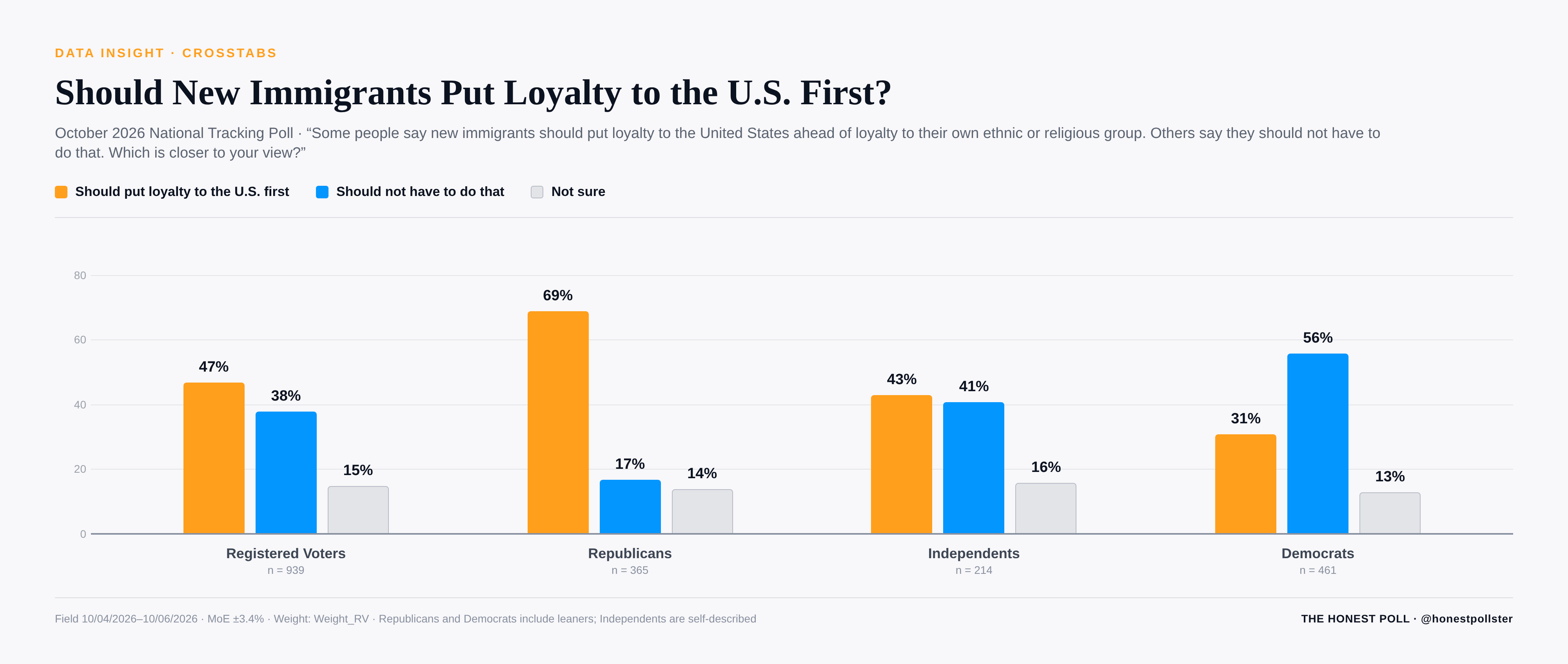
Voters were asked whether new immigrants should put loyalty to the United States ahead of loyalty to their own ethnic or religious group, and how much it personally bothers them to be called racist.
A new national survey by The Honest Poll finds that 50% of Likely Voters say new immigrants should put loyalty to the United States first, while 38% say they should not have to do that and 13% are not sure. Among all Registered Voters, 47% say loyalty to the United States should come first, 38% say it should not, and 15% are not sure.
The split is largely partisan. Sixty-nine percent (69%) of Republicans say new immigrants should put loyalty to the United States first, compared with 31% of Democrats, while 56% of Democrats say they should not have to do that, compared with 17% of Republicans. Independents are evenly divided, 43% to 41%. By 2024 vote, Trump voters say loyalty to the United States should come first 71% to 15%, while Harris voters say immigrants should not have to do that 57% to 30%. Conservatives say loyalty to the United States first 71% to 19%, moderates 42% to 38%, and liberals say immigrants should not have to do that 66% to 23%. Voters who strongly approve of the job Donald Trump is doing say loyalty to the United States first 82% to 10%, while those who strongly disapprove say immigrants should not have to do that 59% to 26%.
Age and gender add a second pattern. Baby Boomers say loyalty to the United States first 54% to 33%, Generation X 45% to 37% and Millennials 46% to 40%, while Generation Z is closely divided, 41% to 44%. Men say loyalty to the United States first 51% to 36% and women 44% to 39%, and the gender difference is larger among younger voters. Men under 40 say loyalty to the United States first 48% to 37%, while women under 40 say immigrants should not have to do that 48% to 39%, the only age-by-gender group in which more say they should not have to than say loyalty to the United States should come first. Among voters 40 and older, men say loyalty to the United States first 53% to 36% and women 46% to 36%.
White voters say loyalty to the United States first 50% to 35%, Hispanic voters are evenly divided at 40% to 42%, and Black voters say immigrants should not have to do that 49% to 36%. Responses vary little by education, with between 47% and 51% of each group, from high school graduates to those with graduate degrees, saying loyalty to the United States should come first.
Voters were also asked how much it personally bothers them to be called racist. Among Likely Voters, 50% say it bothers them a lot, 17% say some, 9% say a little and 20% say not at all, with 5% not sure. Registered Voters answer 48%, 17%, 10%, 20% and 6%, so 65% of Registered Voters say being called racist bothers them at least some.
Women are more likely than men to say being called racist bothers them a lot, 54% to 42%. Men under 40 are the least likely of any group to say it bothers them a lot, at 33%, compared with 46% of men 40 and older, 48% of women under 40 and 56% of women 40 and older. Twenty-five percent (25%) of men under 40 say it bothers them some and 21% say not at all, while men 40 and older are the most likely to say not at all, at 29%, compared with 13% of women under 40 and 15% of women 40 and older. Taking a lot and some together, 58% of men under 40 and 58% of men 40 and older say it bothers them, compared with 70% of women under 40 and 71% of women 40 and older.
Democrats are more likely than Republicans to say being called racist bothers them a lot, 55% to 41%, while 26% of Republicans and 14% of Democrats say it does not bother them at all. Liberals say it bothers them a lot 65% of the time and conservatives 37%. By generation, 57% of Baby Boomers say it bothers them a lot, compared with 48% of Generation X, 42% of Generation Z and 39% of Millennials.
The two questions are related. Among voters who say new immigrants should not have to put loyalty to the United States first, 56% say being called racist bothers them a lot, compared with 43% of those who say loyalty to the United States should come first. Among voters who say being called racist bothers them a lot, 43% say loyalty to the United States first and 44% say immigrants should not have to do that, while among those who say it does not bother them at all, 57% say loyalty to the United States first and 29% say they should not have to.
Never miss a poll.
Get free notifications the moment we publish. Topline results, no spin, no narrative — just the numbers.
The survey of 939 Registered Voters, including 780 Likely Voters, was conducted October 4-6, 2026, by The Honest Poll, combining an online panel with an SMS text survey, weighted to match known demographic and political benchmarks. The margin of sampling error for the full sample is +/- 3.4 percentage points at a 95% level of confidence; the margin of error is higher for subgroups, including age-by-gender groups.