Republicans and Democrats Alike Back Taxing the Rich and Reining In Big Corporations
Voters were asked how they would prefer to address the federal debt, how they view corporate taxation and the growing size of large companies, and which political party they see as more influenced by corporate money.
A new national survey by The Honest Poll finds that if forced to choose one way to reduce the federal debt, 54% of Registered Voters would raise taxes on households earning over $1 million a year, 23% would cut defense spending, and 11% would cut future Social Security and Medicare benefits. Eleven percent (11%) are not sure. Likely Voters answer almost identically: 56% would raise taxes on top earners, 23% would cut defense spending, and 11% would cut Social Security and Medicare.
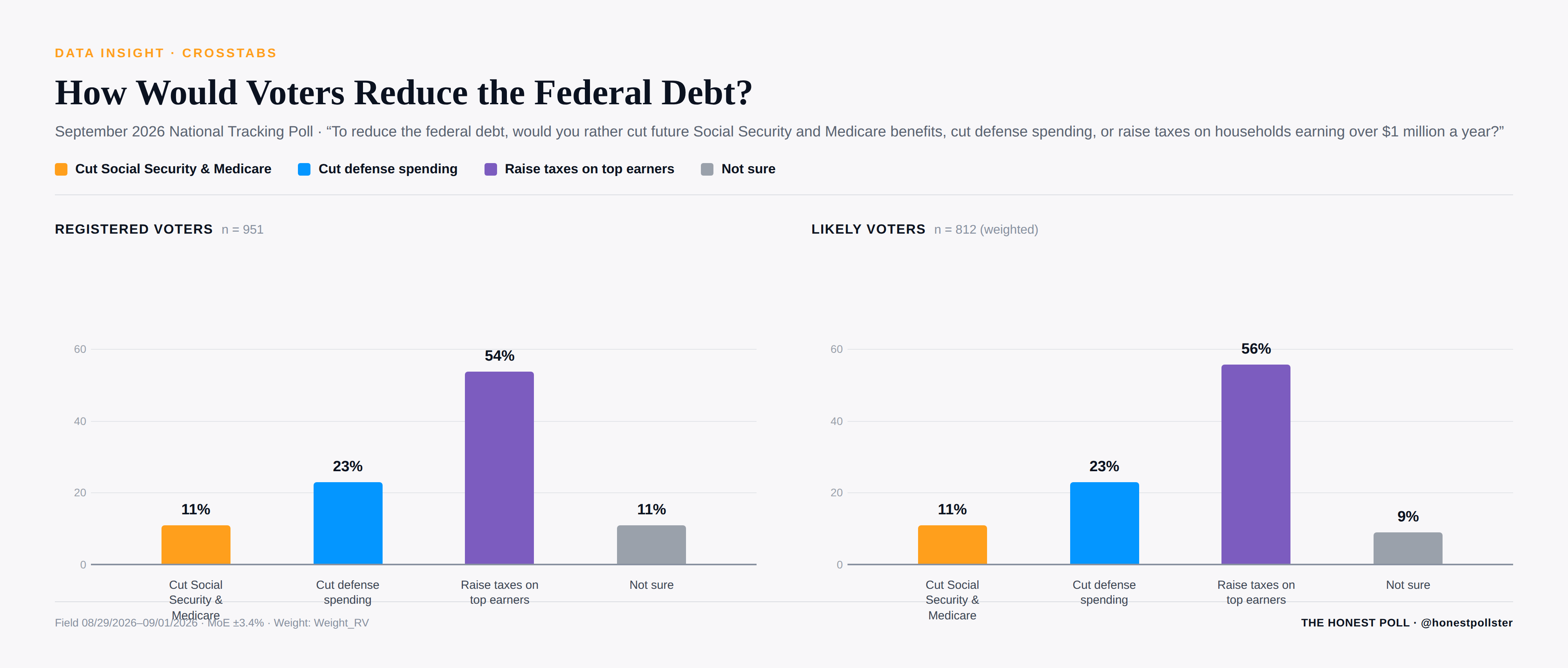
The preference for taxing high earners over touching entitlements or defense spending holds even among groups usually assumed to oppose tax increases. Fifty-one percent (51%) of Republicans and 50% of 2024 Trump voters would rather raise taxes on million-dollar earners than cut Social Security, Medicare, or defense, compared with 59% of Democrats, 63% of 2024 Harris voters, and 44% of independents. Self-identified conservatives divide the same way: 48% would raise taxes on top earners, the single largest response, while 21% would cut defense spending and 16% would cut Social Security and Medicare. The sharpest divide on this question is generational rather than partisan — just 35% of Generation Z voters would raise taxes on high earners, compared with 74% of Baby Boomers, with far more younger voters willing to cut Social Security and Medicare (26%) or defense spending (29%) instead.
A similar pattern holds on corporate taxation. Asked which comes closer to their view — that cutting corporate taxes further is the best way to grow the economy, or that corporations already get too many tax breaks — 63% of Registered Voters, and 64% of Likely Voters, said corporations already get too many breaks, compared with 25% who said further corporate tax cuts would boost growth. Half of Republicans (50%) and 53% of 2024 Trump voters said corporations already get too many tax breaks, not far behind the 74% of Democrats and 75% of Harris voters who said the same. Self-described conservatives were closely divided, 48% to 37%, but still landed on the side of too many tax breaks rather than more of them.
Voters also lean toward more government intervention against corporate concentration. Combining those who strongly or somewhat support the idea, 63% of Registered Voters, and 65% of Likely Voters, support stronger government action to break up large corporations that dominate industries like technology, agriculture, healthcare, and banking, while 21% are opposed. Support is nearly identical across the 2024 electorate: 62% of Trump voters and 66% of Harris voters back stronger antitrust action. Sixty-one percent (61%) of Republicans support it, as do 64% of self-identified conservatives, both higher than the 56% support level among self-described moderates.
Voters see the Republican Party, not the Democratic Party, as more influenced by corporate money. Forty-four percent (44%) of Registered Voters say Republicans are more influenced by big business and wealthy donors, compared with 22% who say Democrats are, 28% who say both parties are equally influenced, and 2% who say neither is. That view is not confined to Democrats: 35% of Republicans say their own party is more influenced by big business, and another 37% say both parties are equally influenced, meaning nearly three in four Republicans do not describe their own party as free of corporate influence. Trump voters answer almost identically, with 36% pointing to the Republican Party and 35% saying both parties equally. Independents mostly decline to take a side, with 46% saying both parties are equally influenced by big business — far more than the 21% who blame Republicans specifically or the 7% who blame Democrats — while 10% say neither party is influenced and 16% are not sure, the highest share of any group measured.
Never miss a poll.
Get free notifications the moment we publish. Topline results, no spin, no narrative — just the numbers.
The survey of 951 Registered Voters, including 812 Likely Voters, was conducted August 29-September 1, 2026, by The Honest Poll, combining an online panel with live Interactive Voice Response calls, weighted to match known demographic and political benchmarks. The margin of sampling error for the full sample is +/- 3.4 percentage points at a 95% level of confidence; the margin of error is higher for subgroups, including the 7% of respondents who identify as independent.