Most Americans Say the Economy Works for the Wealthy, Not Everyday People
A new national survey by The Honest Poll finds that just 27% of adults rate the U.S. economy as excellent or good, while 68% call it fair or poor, including 40% who call it poor outright. Only 16% of adults say economic conditions are getting better, compared with 57% who say they are getting worse and 21% who say things are staying about the same. Personal finances read somewhat less bleak: 36% of adults rate their own finances as excellent or good, and 19% say their finances are improving, while 39% say they are getting worse.
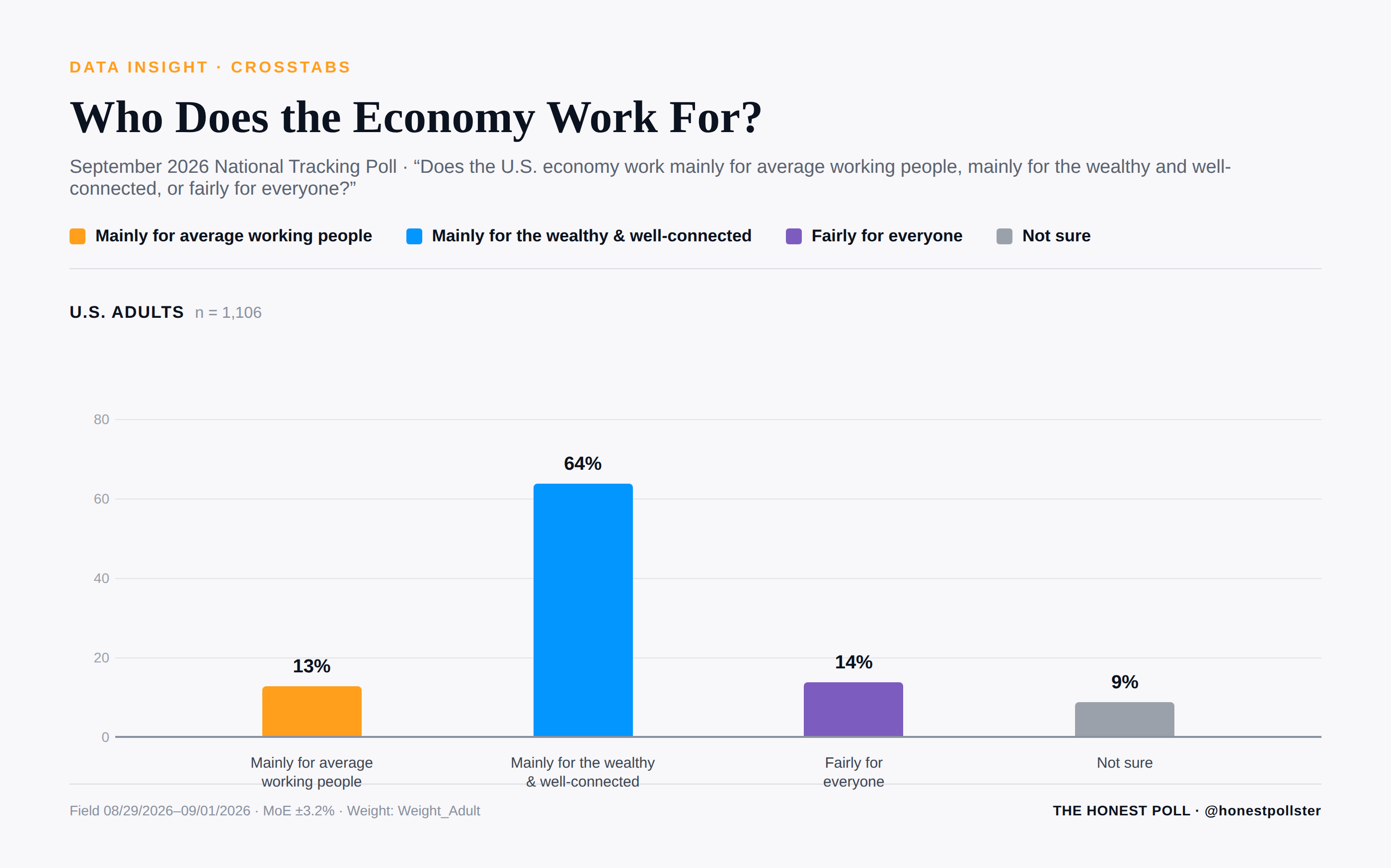
Asked whether the U.S. economy works mainly for average working people, mainly for the wealthy and well-connected, or fairly for everyone, 64% of adults say it works mainly for the wealthy and well-connected, compared with just 13% who say it works for average working people and 14% who say it works fairly for everyone. That view crosses party lines: a majority of Republicans (51%) and 2024 Trump voters (51%) agree the economy works mainly for the wealthy, even as far more Democrats (79%) and Harris voters (80%) say the same, a 28-point gap. Age shows a similar-sized split: 55% of Generation Z say the economy favors the wealthy, compared with 73% of Baby Boomers, an 18-point gap, and Generation Z is nearly four times as likely as Boomers to say the economy works fairly for average people, 23% to 6%.
Asked whether children growing up in America today will have a better, worse, or about the same standard of living as their parents, 53% of adults say worse, compared with 17% who say better and 19% who say about the same. Pessimism is sharply partisan: 67% of Democrats and 66% of Harris voters say children will be worse off, compared with 38% of Republicans and 39% of Trump voters. It is also generational, though not in the direction that pessimism about the wealthy might suggest — Baby Boomers are the most pessimistic generation on this question, with 59% saying worse, compared with 46% of Generation Z, the least pessimistic group measured, while Millennials are the most likely of any generation to say children will be better off, at 23%.
Personal financial trajectories follow a similar generational pattern. Twenty-five percent (25%) of Generation Z and 24% of Millennials say their own finances are improving, compared with 15% of Generation X and just 13% of Baby Boomers — the same rough ordering, younger to older, that shows up in views of the economy overall and of the next generation's prospects.
Trust in government follows a different pattern. Combining those who trust the government in Washington to do what's right just about always or most of the time, 26% of adults express high trust, while 68% say they trust the government only some of the time or never, including 28% who say never. That trust splits by party in the direction that typically follows control of the White House: 37% of Republicans and 39% of 2024 Trump voters express high trust, compared with 19% of Democrats and 17% of Harris voters. But the sharper divide runs by age. Forty-two percent (42%) of Generation Z say they trust the government just about always or most of the time, more than double the 18% of Baby Boomers and nearly double the 23% of Generation X who say the same, and just 17% of Generation Z say they never trust the government, compared with 32% of Baby Boomers.
Never miss a poll.
Get free notifications the moment we publish. Topline results, no spin, no narrative — just the numbers.
The survey of 1,106 U.S. adults was conducted August 29-September 1, 2026, by The Honest Poll, combining an online panel with live Interactive Voice Response calls, weighted to match known demographic and political benchmarks. The margin of sampling error for the full sample is +/- 3.2 percentage points at a 95% level of confidence; the margin of error is higher for subgroups.