More Voters Blame the U.S. Than Iran for the Iran Conflict
Voters were asked who they blame most for the ongoing conflict involving Iran and how much it will matter when they vote in November.
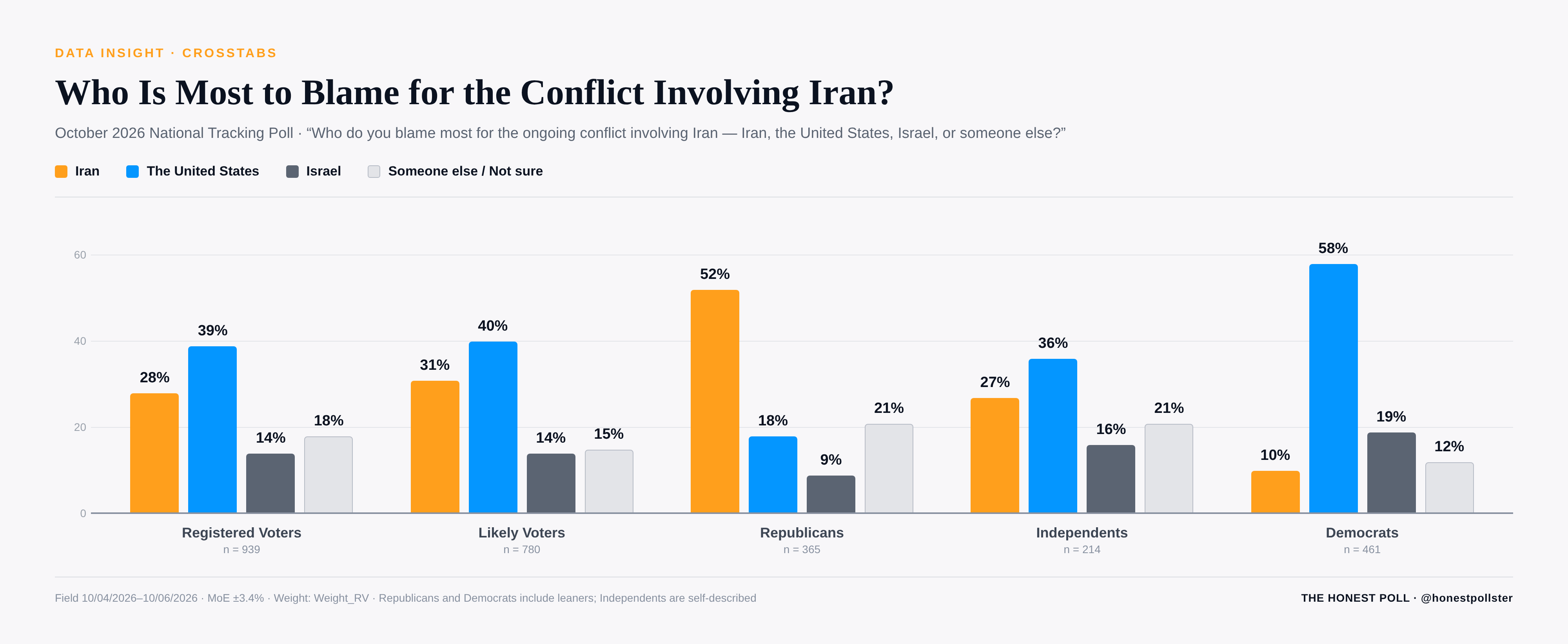
A new national survey by The Honest Poll finds that 40% of Likely Voters blame the United States most, ahead of the 31% who blame Iran and 14% who blame Israel. Three percent (3%) name someone else and 12% are not sure. Registered Voters answered 39% the United States, 28% Iran, 14% Israel, 3% someone else and 15% not sure.
Party is the clearest dividing line. A majority of Republicans, 52%, blame Iran, while 18% blame the United States and 9% Israel. Democrats are close to the reverse: 58% blame the United States, 19% Israel and only 10% Iran. Independents fall in between at 36% the United States, 27% Iran and 16% Israel. The 2024 vote sorts the same way, with 52% of Trump voters naming Iran and 62% of Harris voters naming the United States. Ideology shows the same split: 50% of conservatives blame Iran and 5% of liberals do, while 63% of liberals blame the United States against 25% of conservatives.
Views of the president track the answer closely. Voters who strongly approve of Donald Trump's job performance blame Iran 56% to 22%, and those who strongly disapprove blame the United States 59% to 11%. Voters who somewhat approve are the least settled, with 42% naming Iran, 21% the United States and 23% not sure. Direction of the country works the same way: voters who think things are headed in the right direction blame Iran 49% to 28%, while those on the wrong track blame the United States 47% to 19%.
Age shows a steady gradient. Blame on Iran rises with each generation, from 12% of Gen Z to 20% of Millennials, 33% of Gen X and 39% of Baby Boomers, and Israel moves the other way, named by 25% of Gen Z and 17% of Millennials but just 11% of Gen X and 9% of Boomers. Men under 40 are the likeliest to name Israel at 29%, roughly double the 15% of women under 40 and well above the 10% of men and 11% of women who are 40 or older. Women under 40 lean hardest toward the United States, at 48%. Women overall are more than twice as likely as men to say they are not sure, 21% to 8%.
Black voters blame the United States over Iran by 58% to 10%, the widest margin of any racial group. White voters are nearly even, at 36% the United States and 33% Iran, and Hispanic voters name the United States 36%, Iran 26% and Israel 19%.
On the vote itself, 11% of Registered Voters call the conflict the single most important issue in deciding their vote, 35% put it among their top three, 36% describe it as one of several issues, and 11% say it is not significant. Seven percent (7%) are not sure. Likely Voters answered 12%, 36%, 37%, 10% and 5%.
Younger voters rank the conflict highest. Twenty-four percent (24%) of Gen Z call it the single most important issue, as do 16% of Millennials, 6% of Baby Boomers and 4% of Gen X. That holds for both sexes under 40, at 20% of men and 22% of women, against 7% of men and 6% of women 40 and older. Party makes little difference at the top: 11% of Republicans and 12% of Democrats call it their first priority. Independents are the least likely to rank it first or in their top three, at 35%, against 43% of Republicans and 50% of Democrats.
The two questions are linked. Among voters who call the conflict the single most important issue, 58% blame the United States and 19% blame Iran, while among those who say it is not a significant issue, 44% blame Iran and 17% the United States. Looked at from the other side, 57% of voters who blame the United States and 58% of those who blame Israel rank the conflict first or in their top three, compared with 41% of those who blame Iran.
Never miss a poll.
Get free notifications the moment we publish. Topline results, no spin, no narrative — just the numbers.
The survey of 939 Registered Voters, including 780 Likely Voters, was conducted October 4-6, 2026, by The Honest Poll, combining an online panel with an SMS text survey, weighted to match known demographic and political benchmarks. The margin of sampling error for the full sample is +/- 3.4 percentage points at a 95% level of confidence; the margin of error is higher for subgroups, including age-by-gender groups.