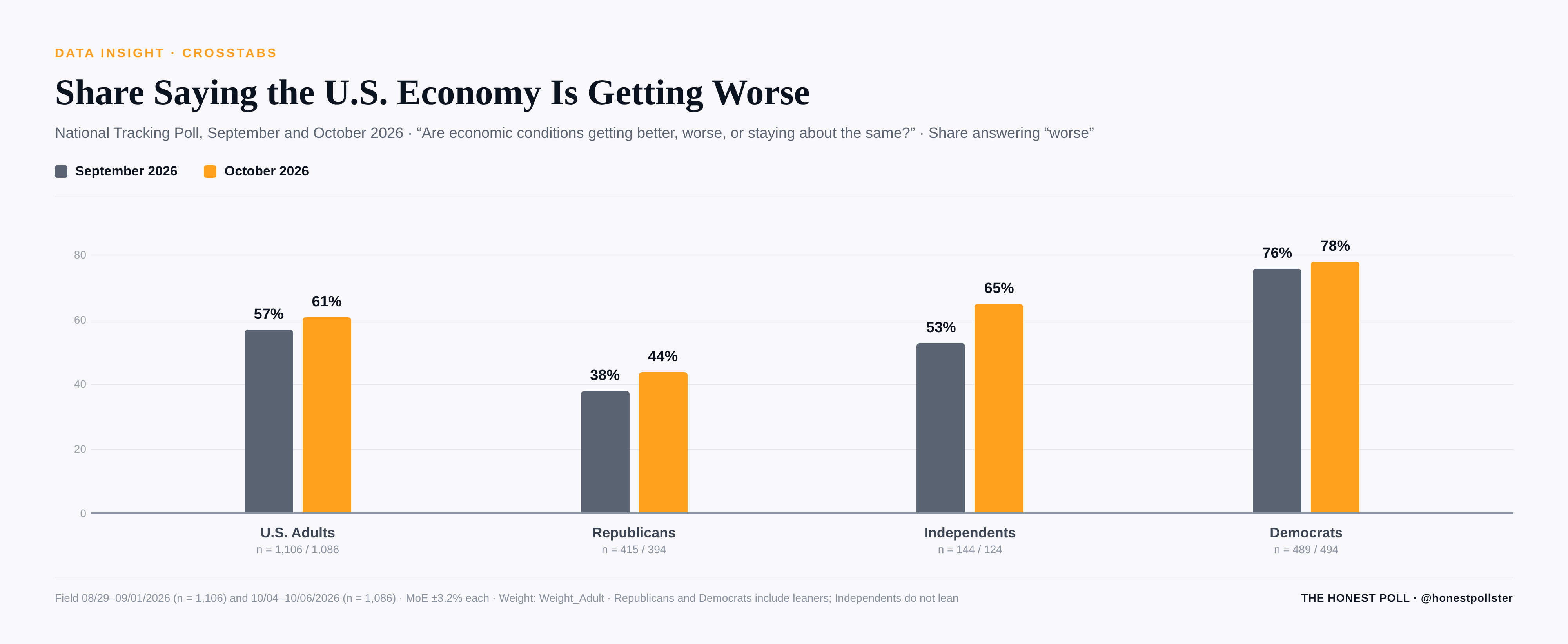
More Adults Say the Economy Is Getting Worse, 61% Against 57% in September
Adults were asked how they rate the economy and their own finances, which way each is heading, whether children will be better off than their parents, who the economy works for, and how often they trust the government in Washington. The questions repeat those from the previous monthly tracking survey, conducted at the end of August.
A new national survey by The Honest Poll finds that 61% of Adults say economic conditions are getting worse, up from 57% in September. Fourteen percent (14%) say conditions are getting better, down from 16%, and 20% say they are staying about the same, compared with 21% a month ago. Five percent (5%) are not sure.
Views of personal finances moved the same way. Forty-three percent (43%) say their own finances are getting worse, up from 39%, while 16% say they are getting better, down from 19%. Thirty-two percent (32%) rate their personal finances excellent or good, compared with 36% in September, and 65% rate them fair or poor, up from 61%. The rating of the national economy itself was little changed, with 27% calling it excellent or good in both surveys, though the share calling it poor is 43%, up from 40%.
The shift is concentrated among independents and Republicans. Independents saying the economy is getting worse rose from 53% to 65%, and the share rating the economy fair or poor rose from 65% to 80%, including 51% who call it poor, up from 40%. Among Republicans, 44% now say the economy is getting worse, up from 38%, and 24% say it is getting better, down from 30%. Democrats, who were already the most negative, were little changed at 76% in September and 78% now. Voters' 2024 choices show the same split: 42% of Trump voters say the economy is getting worse, up from 36%, while Harris voters are at 79%, compared with 78% before.
Personal finances follow a similar pattern by party. Republicans rating their finances excellent or good fell from 50% to 41%, and those saying their finances are getting worse rose from 26% to 33%. Among Trump voters, the share saying their finances are getting worse is 32%, up from 24%. Democrats were steady, with 27% rating their finances excellent or good in September and 28% now.
Adults in the middle of the Trump approval scale moved the most. Of those who somewhat disapprove of his job performance, 85% now rate the economy fair or poor, up from 71%, and 54% say their own finances are getting worse, up from 41%. Among those who somewhat approve, 52% say the economy is getting worse, up from 44%. Strong approvers remain the most positive group but also slipped, with 46% saying conditions are getting better, down from 53%. Those who strongly disapprove were nearly unchanged, at 84% in September and 86% now saying the economy is getting worse.
Among generations, Gen Z moved the most. In September, Gen Z was the generation least likely to say children will have a worse standard of living than their parents, at 46%. It is now at 57%, tied with Baby Boomers (59% in September) as the most pessimistic generation, while Millennials are the least, at 50%. Gen Z adults rating their own finances excellent or good fell from 44% to 37%, and those saying their finances are getting worse rose from 31% to 40%. Gen X is at 64% saying the economy is getting worse, up from 58%, while Millennials (57% to 60%) and Baby Boomers (61% to 64%) moved less.
Black adults rating their own finances excellent or good fell from 39% to 24%, and the share rating the economy poor rose from 38% to 49%. The share who say the economy works mainly for average working people dropped from 23% to 11%, and 52% now say children will be worse off than their parents, compared with 42% in September. By household income, the decline was largest in the $35,000 to $65,000 range, where adults rating their finances excellent or good fell from 37% to 25% and those saying the economy is getting better fell from 21% to 14%. Households earning $65,000 to $100,000 moved the other way on the economy rating, with 33% now calling it excellent or good, up from 24%. Adults who are unemployed and looking for work also moved down: 5% say the economy is getting better, compared with 17% before, and 12% rate their finances excellent or good, compared with 24%.
Women moved further than men. Women saying the economy is getting worse rose from 60% to 65% and those saying their finances are getting worse from 42% to 47%, compared with 55% to 57% and 37% to 39% for men.
The broader measures of how the economic system works did not change. Fifty-four percent (54%) of Adults say children growing up today will have a worse standard of living than their parents, against 53% in September, while 16% say better, compared with 17%, and 17% say about the same, compared with 19%. Sixty-three percent (63%) say the economy works mainly for the wealthy and well-connected, against 64%, while 12% say mainly for average working people and 15% say fairly for everyone. Trust in the government in Washington is also unchanged, with 26% trusting it just about always or most of the time and 68% only some of the time or never, though independents are an exception: 77% of them say only some of the time or never, up from 64%.
Never miss a poll.
Get free notifications the moment we publish. Topline results, no spin, no narrative — just the numbers.
The survey of 1,086 Adults was conducted October 4-6, 2026, by The Honest Poll, combining an online panel with an SMS text survey, weighted to match known demographic and political benchmarks. The margin of sampling error is +/- 3.2 percentage points at a 95% level of confidence; the margin of error is higher for subgroups and for comparisons with the earlier survey. September comparison figures come from a survey of 1,106 Adults conducted August 29 to September 1, 2026, which combined an online panel with an automated telephone (IVR) survey.